Scenes from a Chinese marriage
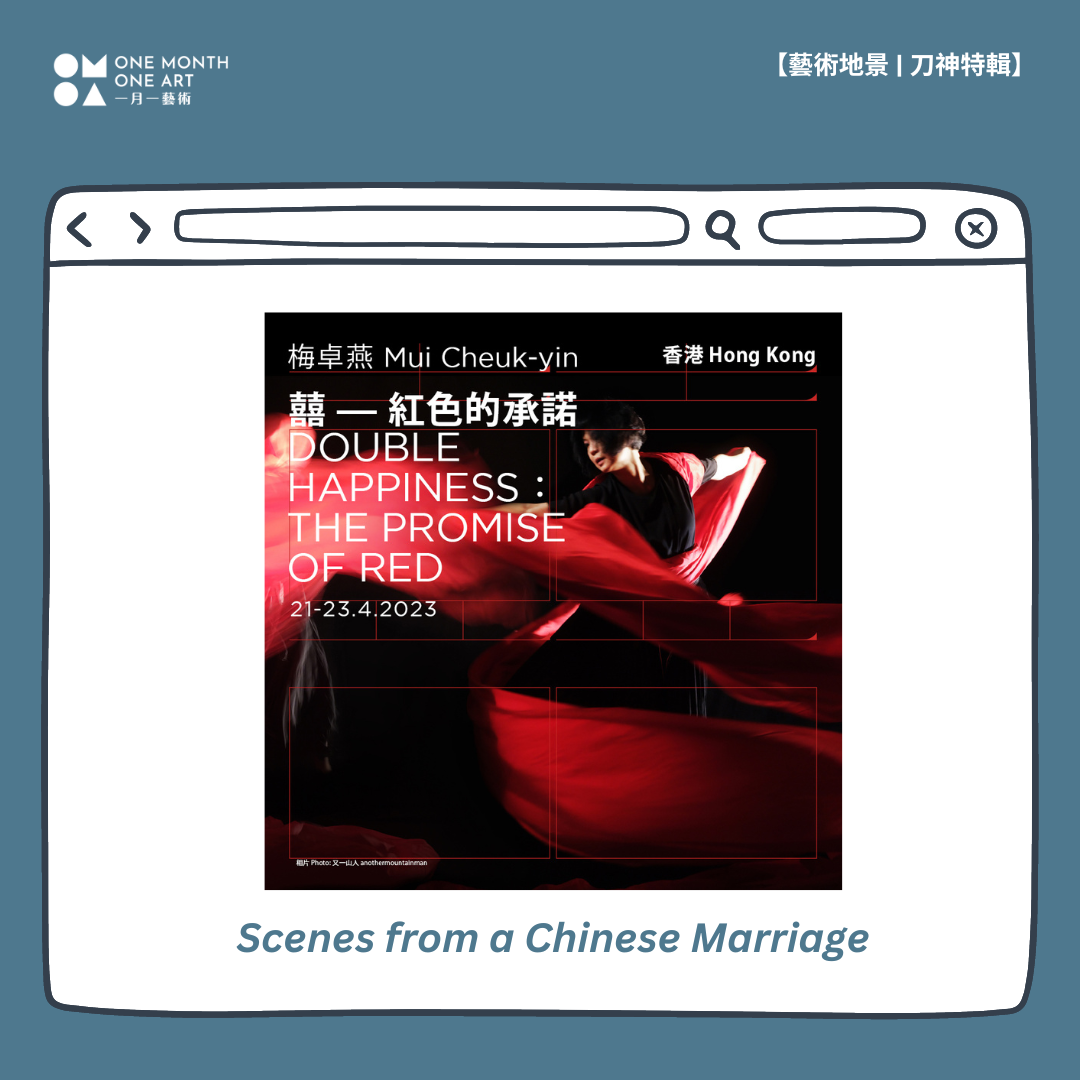
Ever since Bergman’s monumental film 49 years ago, rarely has there been an artwork as dedicated to offering a sobering take-down on matrimony as Mui Cheuk-yin’s Double Happiness: The Promise of Red, despite their differences in medium. While Bergman has presented a minute dissection on the breakdown of a marriage between a white, middle-class Swedish couple, Mui’s version takes aim at heterosexual marriages under the patriarchy within the Chinese context, blending elements of Cantonese opera tale, the singing of bridal laments from older generation of Hong Kong village women, as well as Guangdong wedding rituals. The result of this, amounts to a bald, ambitious, and timely performance.
The way Mui’s work operates on the duality is perhaps best expressed in its English title, “Double Happiness”, just as marriage itself is often, at best, a double-edged sword. These paradoxes, such as white and red, happy ending and tragedy, life and death, and even the use of a bittersweet mask, have been repeatedly presented throughout the performance. The white costume donned by Mui and the wedding chaperon, Chan Kin-man, which is traditionally worn in western wedding, is nonetheless a bad omen in any Chinese celebrations and making the dominant red motif all the more unnerving. The colour red dominates the title, set design and props, yet it is subverting its connotation in Chinese culture as a good omen and prosperity, here it acts as a recurring symbol for danger as siren, fire hydrant, chains and burner bucket for joss paper in blaring red sit on the stage for the entire duration. Its overwhelming nature also creating a spectral aspect to the setting. The striking back drop made with two huge red ribbons creating a cross, combined with the trampoline to evoke the image of an altar, then an attic, which is where bridal laments were sang traditionally (the only way women were able to condemn arranged marriage in the feudal society moments before they were married off), and finally a bed.
This is when Mui delivered scene 5, featuring perhaps her most visceral choreography in the performance. In a scene that is supposed to represent the bed setting ceremony, she not only uses the text from The Flower Princess, where Princess Changping is asked to die in the honour of her country and her family and borrows the use of ribbon in that particular scene, to deliver her most damning take on the violence of marriage and childbirth. The red ribbons come to represent marriage and its rituals as an arduous task and female pain, as well as the binding nature of matrimony. This is again reflected in the choking motif twice appeared in her choreography, the evocation of incarcerated nightingale, and how the projection of the Chinese character “Happiness(囍)” in the end that casts the imprisoning shadow of patriarchy and marriage. Even in the lyrics of scene 6, where “green and red carrot soup” is mentioned, a chilling reference which most Hong Kongers could instantly recognised, once again reaffirms to the notion of the danger of marriage, especially for women.
Written by: Rachelle
📥立即下載1M1A (Link in bio)
🗣️Like & Comment 藝術活動,Art Chat together!
——————————————-
FOLLOW US ON –
Facebook:1m1a.org
Instagram: @1month1art
YouTube:一月一藝術
Website: 1m1a.org
#自由舞 #沒有最壞 #一月一藝術 #劇場導賞 #香港 #藝術 #劇場#討論區 #HongKong #hkart #docent #docenttraining#hkforum #hkevent #hkig